From Repeated Closures to Stability for the Livelihoods Behind a Barber Shop
From Repeated Closures to Stability for the Livelihoods Behind a Barber Shop
May 15, 2026 | Navar Maarri
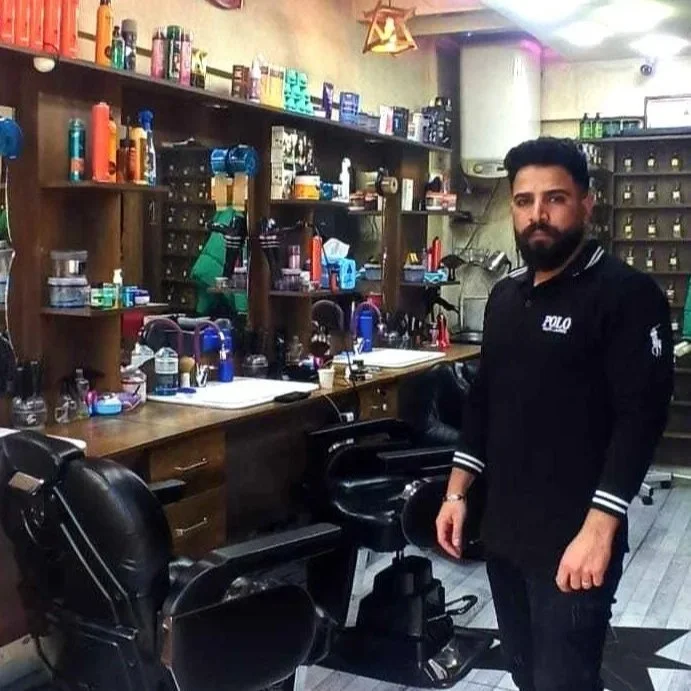
Ahed Al-Ghazawi is a barber from Daraa, Syria, where he built his career and ran his own salon for years before leaving the country.
In 2020, he arrived in Gaziantep with his wife and infant daughter. He returned to barbering immediately, working in local shops and continuing the profession he had practiced for years.
Over time, he settled into one salon. When the owner decided to return to Syria, Ahed took over the shop, made it his own, and renamed it “Kader Salonu”. The business, however, had never been licensed.
At first, this did not seem like a major issue. But as inspections became more consistent, the situation changed. The shop was closed more than four times within 1 month due to the lack of a license. Each closure meant a complete stop to work, often during peak seasons such as holidays and Ramadan, when demand is highest and those days are essential for income.
The impact was not limited to Ahed alone. The salon is a source of income for three households. He employs one worker and trains two young apprentices who are learning the profession.
“This shop supports three households,” Ahed says. “When it closes, it’s not just my loss, it affects everyone working here.”
At that point, RUHSAT support under the Resilient Employment and Socio-Economic Development in Earthquake-Affected Regions of Türkiye (RE-SEED) project came at the right time. After hearing about the project, Ahed applied and was able to complete the full registration process and reopen his salon.
The RUHSAT support covered every step required to operate formally from municipal licensing, Chamber of Commerce registration, obtaining a work permit, notarizing documents, to completing required certifications such as occupational health and safety. It also covers the social security (SGK) contributions for three months, easing the financial pressure during a critical period.
With the salon now licensed, the change is also visible in how customers experience the shop. A registered business brings greater trust—clients can rely on clear, regulated pricing and proper hygiene standards in a service that involves direct contact. This has strengthened the salon’s credibility and helped Ahed build more stable relationships with his customers.
This stability carries additional meaning for Ahed. After the earthquake, despite only minor damage to the shop, he moved his family to Konya for a few months to ensure their safety. When the shop was later closed again due to licensing issues, it brought back that same sense of uncertainty. In this context, support through the Resilient Employment and Socio-Economic Development in Earthquake-Affected Regions of Türkiye (RE-SEED) project helps ensure that small businesses like his can continue operating, providing a level of stability that many are still trying to regain.
Through RE-SEED support, Ahed was also able to access health insurance for himself and his family, an essential need as healthcare costs for Syrian refugees became very costly, especially for families with children. This has provided an added layer of security.
Today, the salon is open, serving both Syrian and Turkish customers and providing full barber services, including haircuts, washing, styling, and grooming. Ahed is now planning to expand the shop by taking over the neighboring space and growing the business further.
Through RUHSAT support, the RE-SEED project ensures that small businesses like Ahed’s can move from uncertainty to stability—keeping businesses running, protecting livelihoods, and supporting families in earthquake-affected regions.
This support is provided under the “Resilient Employment and Socio-Economic Development in Earthquake-Affected Regions of Türkiye (RE-SEED)” project, co-funded by the European Union and the German Federal Ministry for Economic Cooperation and Development, and implemented by Deutsche Gesellschaft für Internationale Zusammenarbeit (GIZ) GmbH in cooperation with the Union of Municipalities of Türkiye and Building Markets.