When Opportunity Sees Ability, Not Disability
When Opportunity Sees Ability, Not Disability
August 4, 2026 | Navar Maarri
Everyone deserves the opportunity to work with dignity. The RE-SEED Project supports businesses to create and formalize jobs while helping qualified people access formal employment. Ahmad Haj Ali's story is one example of that journey.
Before war forced him to leave Syria in 2013, Ahmad Haj Ali worked at the Civil Registry in rural Hama. After losing his brother during the war, he rebuilt his life in Adana, where he still lives with his wife and four children in a refugee camp. Born with a physical disability affecting his left hand, finding stable work became one of the biggest challenges of starting over.
Many of the available jobs in Adana were in agriculture and construction, and employers were often hesitant to hire someone with a physical disability. For years, Ahmad travelled to Hatay to work as a painter. Later, he managed a small shoe shop inside the refugee camp until it closed in 2024.
Most of the jobs Ahmad found were informal. There was no health insurance, no job security, and no protection if he became injured or unable to work. Every day away from work meant a day without income, making it difficult to plan for the future or provide stability for his family.
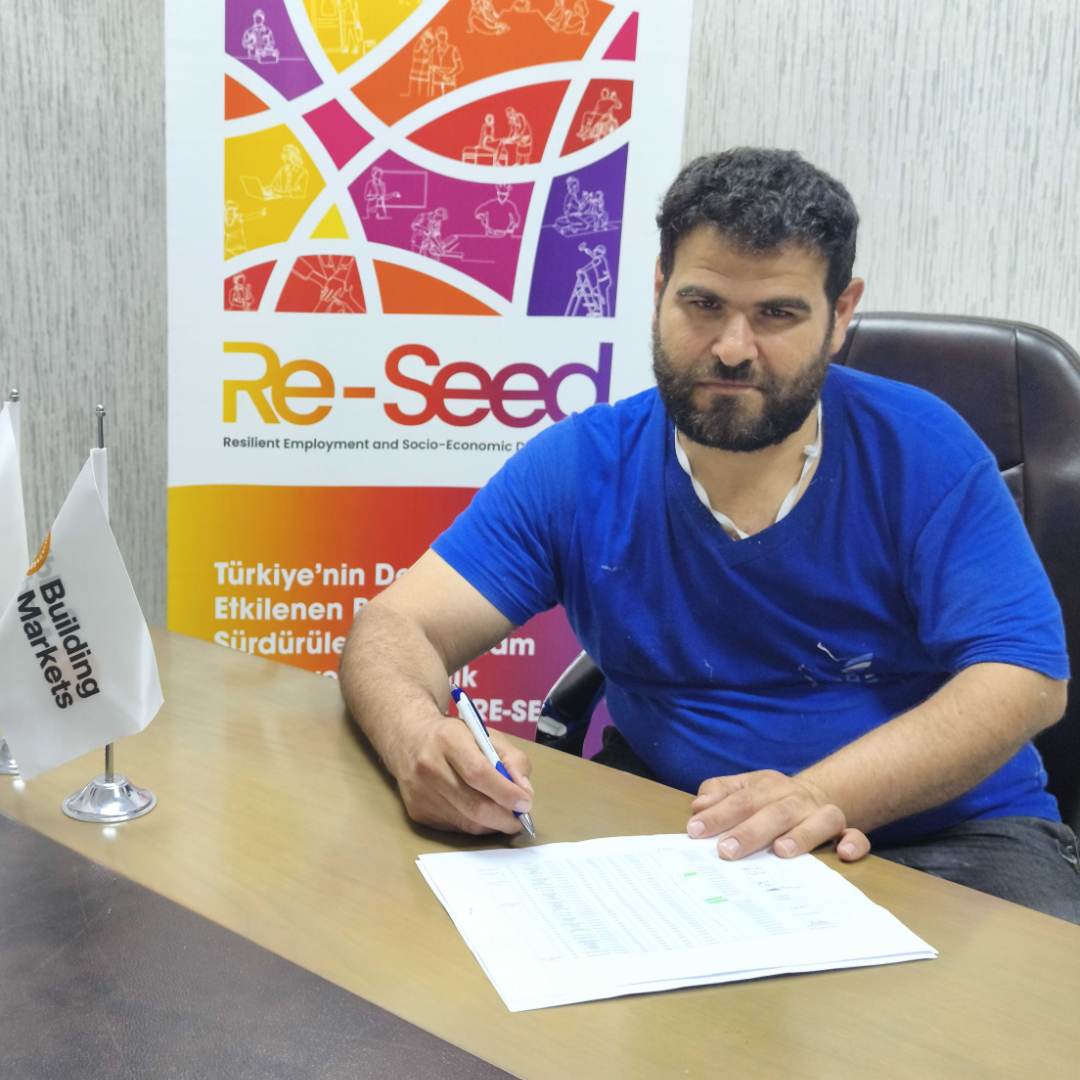
Through the RE-SEED Project's employment support, Building Markets connected Ahmad with a textile company in Adana, while the project supported the employer with a wage subsidy, helping create a formal employment opportunity.
Since February 2026, Ahmad has been working under a formal contract.
"The job I found through the RE-SEED Project changed a lot for me. Today I have health insurance, my rights are protected, and I know my family is more secure. For the first time in years, I can enjoy holidays with my children without worrying about losing my income."
Ahmad's story is one of many made possible through the RE-SEED Project,which helps refugees, women, persons with disabilities, and other vulnerable groups overcome barriers to employment while enabling businesses to access the skilled workforce they need. More inclusive labour markets don't just change individual lives, they strengthen businesses, communities, and local economies.
This support is provided under the “Resilient Employment and Socio-Economic Development in Earthquake-Affected Regions of Türkiye (RE-SEED)” project is co-funded by the European Union and the German Federal Ministry for Economic Cooperation and Development and implemented by Deutsche Gesellschaft für Internationale Zusammenarbeit (GIZ) GmbH in cooperation with the Union of Municipalities of Türkiye and Building Markets.