
Si Dewi’s Journey to Environmental Leadership
Si Dewi’s Journey to Environmental Leadership
August 5, 2024 | Yin Yin Wint
When Building Markets first met Si Dewi in Yangon in 2018, she was balancing two demanding roles: growing a recycling business and caring for her newborn daughter.
Seven years later, her daughter is in school, her business has grown into a thriving recycling enterprise, and Si Dewi has emerged as a respected business leader and advocate for women in Myanmar’s waste and recycling sector.
Her journey is a powerful example of what can happen when an entrepreneur with talent, determination, and a commitment to her community has access to the right tools and opportunities.
Building a Business and a Family
Si Dewi co-manages a recycling business in Yangon with her husband, U Rajar. Together, they buy and sell recyclable materials, including plastics, iron, aluminum, and paper.
When Building Markets first visited her business as part of its Trash to Treasure program, Si Dewi had little familiarity with NGOs or business development programs. Still, she welcomed the team warmly, participating in a business survey while tending to her newborn daughter.
“I instantly knew that Building Markets was something I could trust and that it would give me the opportunity to grow my business,” she recalls.
That first meeting marked the beginning of a seven-year relationship.
Eager to strengthen her business, Si Dewi became an active member of the Building Markets network. She participated in business training, matchmaking, and networking events, while generously sharing what she learned with other entrepreneurs.
Her days often begin at 4 a.m., preparing food and getting her children ready for school before turning her attention to the business. While her husband oversees logistics, transportation, and machinery, Si Dewi manages the company’s finances, employees, and relationships with suppliers and buyers.
Through Building Markets’ training, she began strengthening the systems behind the business.
“After I joined Building Markets’ training, I learned how important it is to manage my finances carefully,” she says. “Now, I make sure everything is accurate before I finish working because I know good bookkeeping is crucial for my business.”
The same philosophy shapes the way she leads her team.
“I want to be a fair and kind employer. I want to lead by example. I don’t just tell my employees what to do. I show them how to do it.”
Creating Opportunity Through Challenging Times
That commitment to her employees became especially important as Myanmar faced extraordinary economic and political challenges, compounded by the COVID-19 pandemic.
Despite the pressure on her business, Si Dewi remained determined to protect the livelihoods of the people who depended on her.
“As a business owner, I believe I need to look after my employees no matter what,” she says. “Even during COVID-19, I didn’t lay off any employees. If I can give a job to one person, I am also supporting their family. It is not all about profits. I feel a sense of fulfillment in doing this.”
As Si Dewi continued investing in her skills and strengthening her business, new opportunities followed.
In 2021, Building Markets supported her in successfully securing a grant from the Responsible Business Fund, funded by the Embassy of Denmark. She used the funding to purchase hydraulic machinery to compress aluminum cans, allowing her to use her space more efficiently, purchase greater volumes of recyclable materials, and increase revenue.
Then, in 2023, Building Markets supported Si Dewi in securing a bank loan worth approximately $142,857 to further expand her business. Through Building Markets’ matchmaking services, she also connected with new businesses and opportunities across the recycling sector.
Over time, the growth of her business was accompanied by something equally important: a transformation in how Si Dewi saw herself and her work.
“I used to think my business had a lower status because it was a junk shop,” she says. “We dealt every day with waste materials that no one wanted to touch. But after joining Building Markets’ training, events, and awareness campaigns, I realized that what I do is good for the environment. Since then, I couldn’t be prouder.”
Becoming a Voice for Other Women
As Si Dewi’s confidence grew, so did her role as a leader in her industry.
At a Building Markets networking event, she took the stage to share her experience applying for and securing financing. Afterward, a woman in the audience approached her.
“I am so glad to see a businesswoman leading in the recycling sector because there are so few women leaders in this field,” she told Si Dewi. “Now you are standing on this stage, bravely sharing your story. I want to be like you.”
The encounter stayed with Si Dewi and strengthened her determination to encourage other women to see themselves as business leaders.
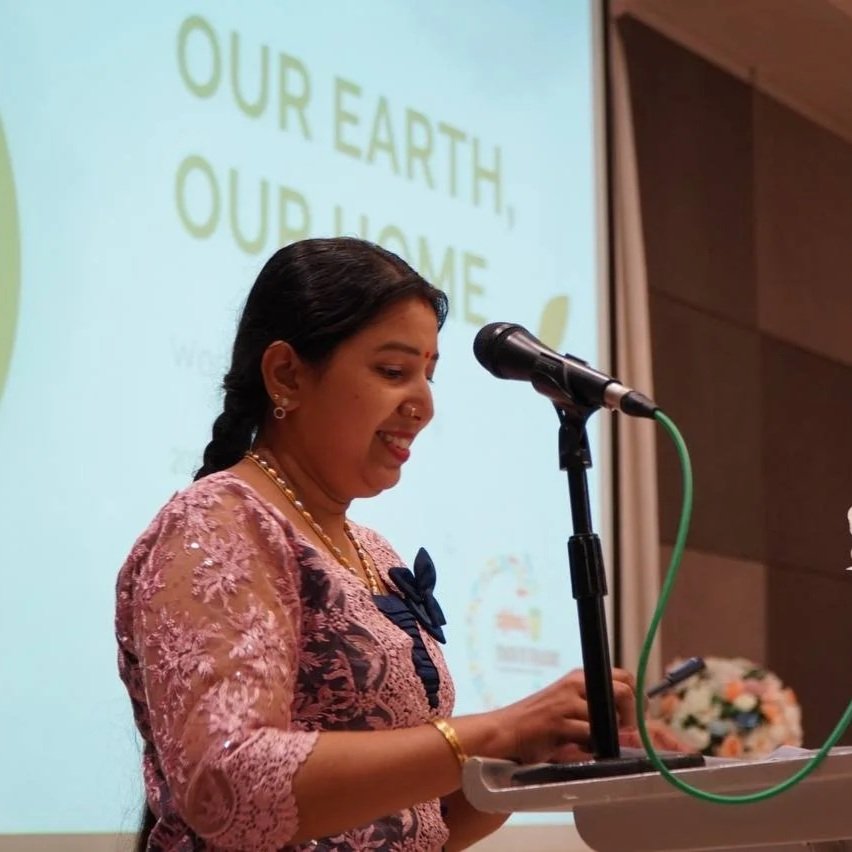
Building Markets later invited her to speak at its World Environment Day event, “Our Earth, Our Home,” where she shared the important role recycling businesses play in protecting the environment and called for more women to take leadership roles in the sector.
For the Building Markets team that had first met Si Dewi seven years earlier, seeing her confidently take the stage was a powerful moment.
Today, Si Dewi’s once modest recycling operation has grown into a well-established business with a strong reputation in Yangon’s recycling market. But her success is measured in more than the size of her company.
It can be seen in the employees whose jobs she protected through difficult times. In the families supported by those livelihoods. In the recyclable materials her business keeps in productive use. And in the women who see her standing on a stage and begin to imagine themselves there, too.
Seven years after Building Markets first met Si Dewi, she continues to learn, grow, and create opportunity for the people around her.
Her journey is a reminder that when entrepreneurs have access to knowledge, financing, markets, and networks, the impact can extend far beyond a single business. It can strengthen families, create jobs, protect communities, and inspire the next generation of entrepreneurs.