Climate & Environmental Sustainability

The Circular Marketplace Program
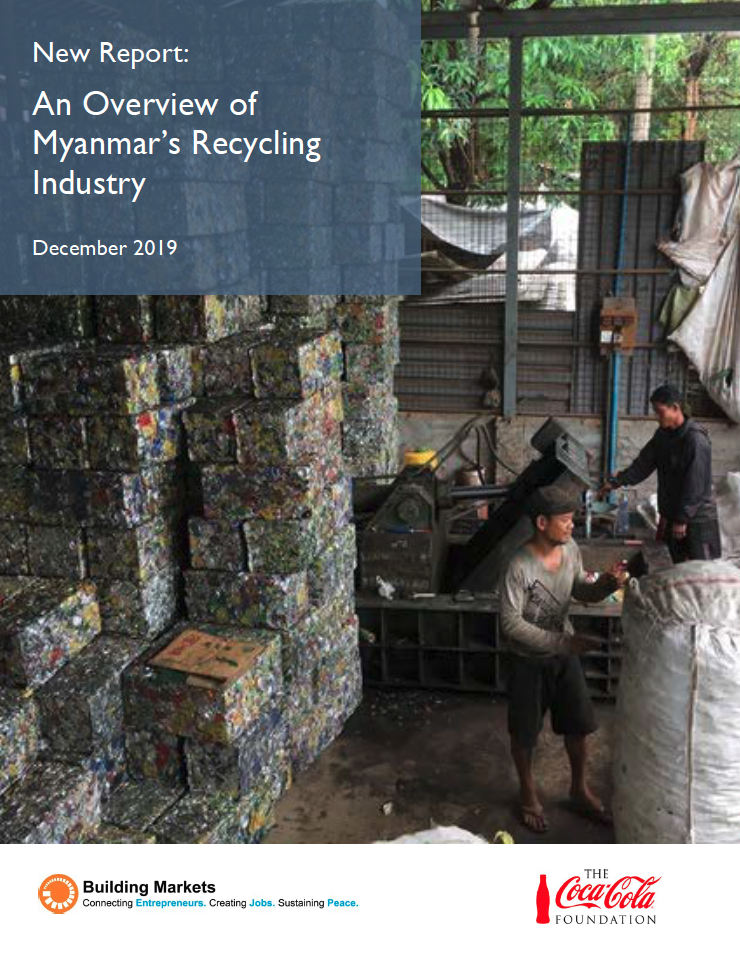
Building Markets’ Circular Marketplace program seeks to address gaps in local waste management ecosystems through coordinated support for waste collectors and the promotion of the circular economy. To date, the Circular Marketplace Program has delivered numerous environmental benefits. Our network of businesses and individuals in the recycling and waste management sectors have collectively processed approximately 30,757.39 tons (27,902.67 metric tons) of PET, 101,067.32 tons (91,686.84 metric tons) of aluminum, and 429,235.33 tons (389,396.20 metric tons) of glass per year, diverting those materials from the landfill. Our activities have resulted in a carbon emissions savings of 4,602,370,365.66 kg CO2e and water savings of 18,896,722.07 m3 of water per year.
Why do small businesses matter in achieving net zero?
A significant portion of large companies’ emissions, up to 90%, comes from their value chains, which are predominately made up of small and medium-sized enterprises (SMEs). These are Scope 3 emissions, which account for the majority of large carbon footprints, including all indirect emissions from supplier activities across a value chain. Including small businesses in the journey toward net zero is imperative, given that they represent 90% of the world’s businesses, provide 60% to 70% of the world’s jobs, and are drivers of Scope 3 emissions.
Sustainability as a transformative opportunity.
Climate investments represent a huge economic opportunity for small businesses — an incentive to change their practices and create a triple-bottom-line benefit for over 2 billion people. Small businesses are often the weakest link in a value chain due to low capacity to combat climate-related issues or lack of information, but investment in sustainability can transform the resiliency of both small businesses and value chains as a whole. Supporting small businesses in their sustainability transformation is essential for developing the green economy, meeting the United Nations (UN) Sustainable Development Goals (SDGs), and achieving the targets established in countries’ national climate plans Nationally Determined Contributions (NDCs).
How We Create Impact
-
We conduct environmental impact assessments using our environmental impact calculator, a tool that we developed and tested with small businesses in Myanmar. This assessment allows firms to understand their carbon emissions and, importantly, start a conversation around how their operations and market positioning might be adjusted to better impact people, profit, and the planet.
-
We provide training courses using sector-relevant case studies and our Circular Economy Toolkit to begin a process of self-assessment and initiative planning for each small business. This helps firms enhance their understanding of sustainable practices and integrate them into business operations to generate environmental performance and value creation.
-
We matchmake across businesses within our network to strengthen sustainable supply chains and increase circularity. We foster connections between environmentally-conscious small businesses and sustainability-focused markets, both locally and globally, to strengthen sustainable supply chains and increase circularity. We also create platforms for small businesses to showcase and promote eco-friendly products and services.
-
To encourage sustainability improvements, we share emerging trends in global, regional, and national environmental regulations; share case studies on corporate initiatives related to Environmental, Social, and Governance (ESG) or Corporate Social Responsibility Directive (CSRD) compliance; support small businesses in receiving funding to transition to renewable energy; and explore how small businesses may participate in and benefit from carbon credit markets.
-
We monitor small business progress against climate and sustainability improvement plans to ensure advancement.
-
We engage with regional and national government partners to mobilize resources and design policies and programs to support small businesses in the sustainability journey.